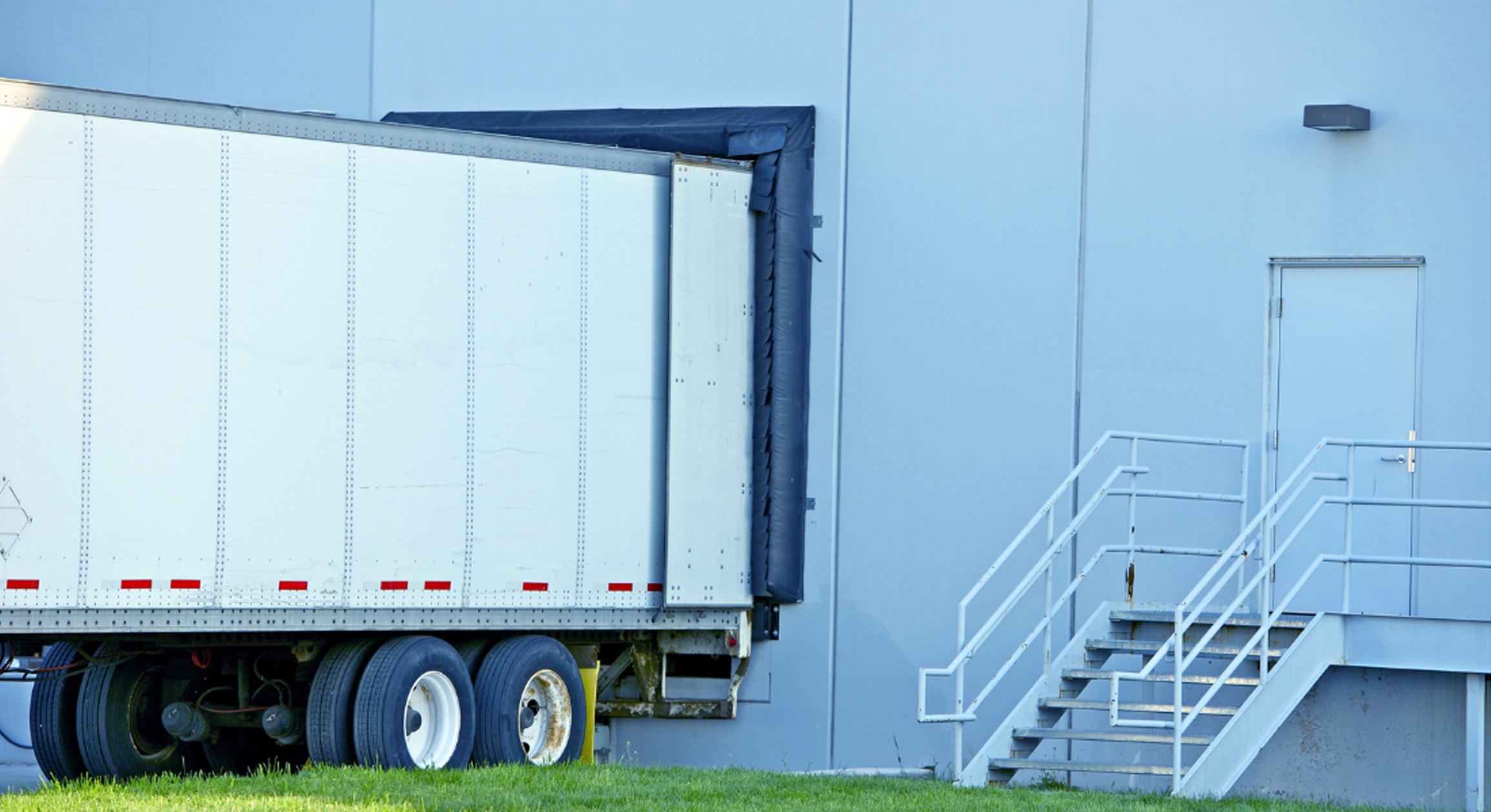
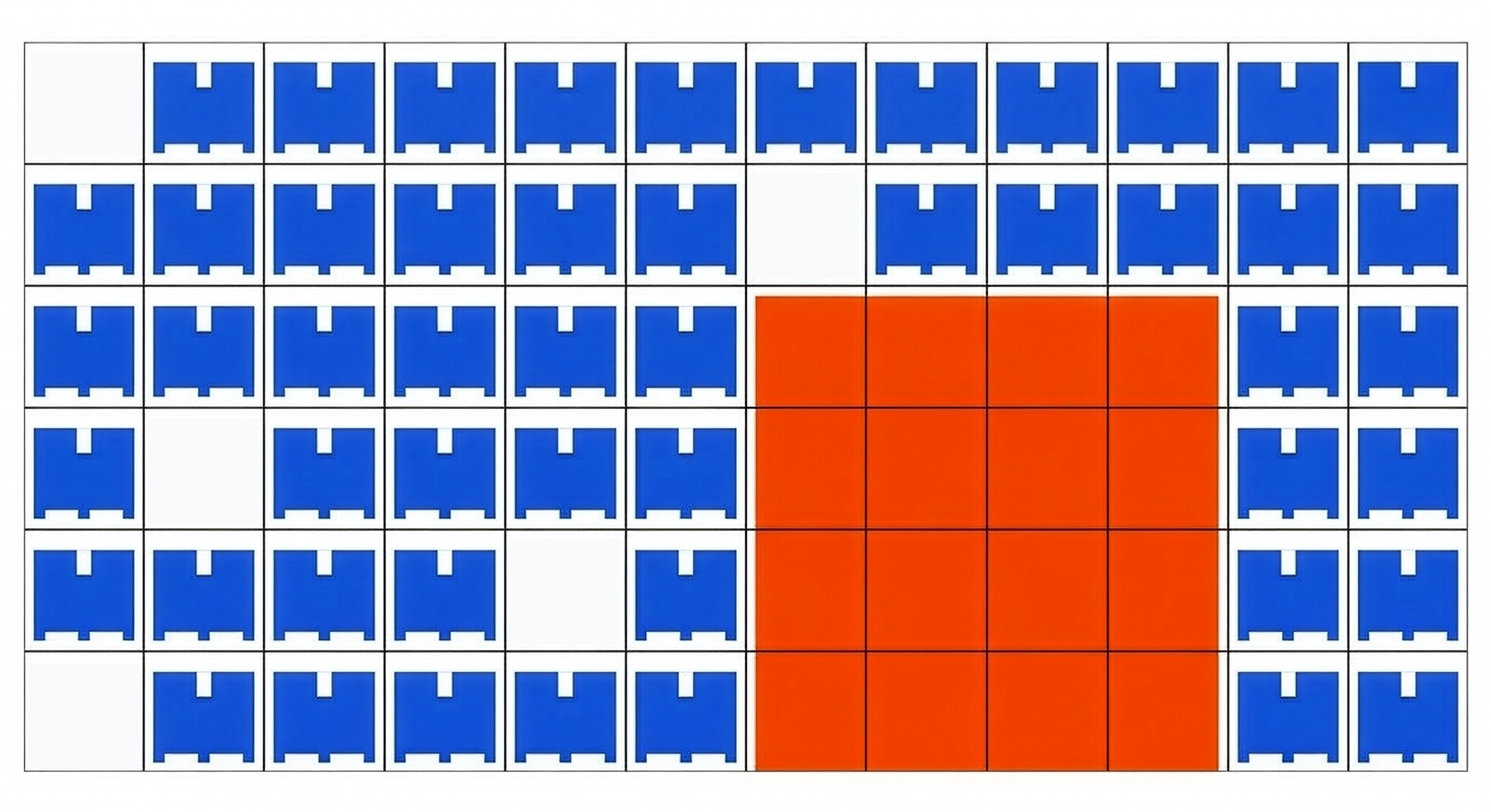

Three pallets? Easy enough.
Five or six still sounds like LTL.
Then the shipment grows.
Eight pallets. Ten. Twelve.
It still does not fill an entire trailer, so it seems logical to keep calling it LTL.
Sometimes that is exactly right.
Sometimes it is not.
The problem is the question itself.
"How many pallets can I ship LTL?" sounds precise, but pallet count is a poor measure of trailer capacity.
Ten pallets of compact, stackable freight and ten oversized, non-stackable pallets are both ten pallets on paper. Inside a trailer, they can be two completely different shipments.
The better question is:
How much of the trailer is this freight actually using?
Once you start there, the line between standard LTL, larger volume shipments and truckload becomes much easier to understand.
There Is No Magic Pallet Number
LTL is built around shared capacity.
Your freight uses part of a trailer, leaving the remaining capacity available for other shipments moving through the carrier's network.
That basic model works well until a shipment starts consuming a disproportionately large amount of that shared space.
And there is no universal industry rule that says this happens at six pallets, eight pallets or twelve pallets.
Different carriers use different thresholds and pricing structures for larger shipments. As one example, Estes currently treats shipments weighing at least 5,000 pounds or occupying at least eight linear feet as eligible for its volume LTL service. Purolator's published Canadian freight tariff applies a linear-foot rating rule once freight occupies 10 feet or more of trailer space. (Estes Express Lines; Purolator)
Those are carrier rules, not universal definitions.
What they show is more important than the numbers themselves:
At a certain point, pallet count stops telling the whole story. Trailer space becomes the more useful measure.
“Pallet count tells you quantity. Linear feet tell you capacity.”
That distinction is the foundation of the whole decision.
Linear Feet Tell You More Than Pallet Count
Linear feet measure the length of trailer floor occupied by a shipment.
If your freight takes up eight feet from the front of the trailer toward the rear, it occupies eight linear feet, regardless of whether that space contains four pallets, six pallets or some awkward combination of freight.
Old Dominion defines linear feet simply as the number of feet a shipment occupies lengthwise inside the trailer. (Old Dominion Freight Line)
That makes linear feet much more useful than pallet count when a shipment starts getting larger.
Imagine two ten-pallet shipments.
The first uses standard pallet footprints, has no overhang and can be positioned efficiently.
The second has oversized product extending beyond the pallets, unusual dimensions and several pieces that cannot be stacked.
Both quotes might begin with:
10 pallets.
But that is where the similarity ends.
One shipment may share trailer capacity efficiently.
The other may consume a large portion of the usable trailer.
That is why the physical shape of the freight matters.
A Practical Four-Question Test
When a shipment starts feeling "big for LTL," pallet count alone is not enough to make the call.
There are four questions worth asking.
1. How much floor space does the freight actually occupy?
Start with the physical footprint.
Not the nominal pallet size. Not what the packaging was supposed to measure.
The actual freight.
Overhang matters. Long material matters. Irregular shapes matter.
A shipment using eight pallet positions inefficiently may occupy more trailer length than a shipment with a higher pallet count that fits neatly together.
This becomes particularly important as the shipment grows because small dimensional differences begin multiplying across several handling units.
2. Can the trailer space around it still be used?
This is where stackability comes in.
A shipment does not only occupy the rectangle of floor beneath it. It can also affect the usable space above and around it.
If a pallet can safely support compatible freight, the carrier has more flexibility.
If the freight is tall, fragile, irregular or explicitly non-stackable, a much larger portion of the trailer may effectively be committed to that shipment.
FedEx Freight Canada's current volume-rate tool illustrates this well. It asks shippers for total weight, linear feet, dimensions, number of handling units and whether the freight is stackable. (FedEx Freight Canada)
That is a useful clue about how larger shipments are actually evaluated.
Nobody is asking only, "How many pallets?"
3. Is weight or space the real constraint?
Some freight fills a trailer because it is heavy.
Other freight fills a trailer because it is bulky.
Those are different problems.
A dense shipment may add substantial weight while occupying relatively little floor space.
A light product may reach the opposite limit. The truck has plenty of payload capacity left, but the usable trailer space is disappearing quickly.
That is why density matters in LTL.
NMFTA calculates handling-unit density using the freight's weight and cubic volume, with dimensions taken at the greatest points of the handling unit as it is actually tendered to the carrier, including projections. (NMFTA)
This is an important mindset shift:
A trailer can be full before it is heavy.
For bulky products, space may be the real capacity constraint long before weight becomes the issue.
4. Does the service still make operational sense?
This question gets overlooked.
A shipment can technically qualify for LTL and still deserve comparison against another option.
Maybe the freight is approaching a significant portion of the trailer.
Maybe it is difficult to stack.
Maybe the dimensions create an awkward footprint.
Maybe the pickup or delivery requirements make the shipment unusually sensitive to handling or timing.
At that point, the question should no longer be:
Can this move LTL?
It should become:
Does LTL still make sense for this shipment?
Those are not the same question.
A Bigger LTL Shipment Does Not Automatically Mean FTL
There is another mistake worth avoiding.
Once a shipment gets large, people often jump straight from LTL to FTL.
But freight does not move neatly between two boxes.
There is a middle ground.
Carriers may offer volume LTL or similar pricing structures for shipments that are larger than conventional LTL freight but still do not require an entire trailer. Estes, for example, explicitly offers volume LTL for larger shipments based partly on weight and trailer space. (Estes Express Lines)
That means a growing shipment should trigger a comparison, not an automatic mode change.
Standard LTL may still work.
Volume LTL may make more sense.
FTL may become competitive.
The right answer depends on the freight itself, the lane, the carrier options available and what the shipment requires operationally.
That is why starting with an arbitrary pallet rule can send the decision in the wrong direction.
Why Actual Dimensions Matter More as the Shipment Grows
Consider a pallet listed as 48 inches long.
The product actually extends three inches beyond the pallet on either side.
For one pallet, the difference might seem minor.
Across several handling units, it can materially change how much trailer space the shipment occupies.
Dimensional data also plays an important role in freight classification and rating.
NMFTA's guidance is explicit that measurements should capture the greatest straight-line dimensions of the handling unit, including projections. In other words, measure the freight that is actually being shipped, not just the pallet underneath it. (NMFTA)
The practical lesson is simpler:
Quote the freight you actually have.
If the freight overhangs, include the overhang.
If it is non-stackable, say so.
If one pallet is unusually tall, capture it.
If the shipment changed after the original dimensions were recorded, update them.
As shipments get larger, small inaccuracies can have a bigger effect on the total footprint.
The Trailer Does Not See Pallet Count
This is probably the easiest way to think about the entire issue.
A trailer does not see "ten pallets."
It sees:
- how much floor has been occupied,
- how much weight has been added,
- whether the remaining space can still be used,
- and how the freight can be positioned around everything else moving with it.
That is why two shipments with the exact same pallet count can justify completely different transportation decisions.
“A shipment does not outgrow LTL when it reaches a magic number of pallets. It outgrows standard LTL when the way it consumes trailer capacity starts behaving differently.”
That is the point where it is worth looking at the shipment again rather than automatically booking it the same way as the smaller loads that came before it.
What Should You Know Before Pricing a Larger LTL Shipment?
If a shipment is starting to occupy a meaningful portion of a trailer, collect the information that describes the freight physically.
At minimum, that means:
- the number of handling units,
- actual weight,
- actual length, width and height,
- whether the freight is stackable,
- any overhang or irregular dimensions,
- the commodity,
- and the pickup and delivery requirements.
From there, estimated linear feet can help show how much trailer length the shipment is actually consuming.
This gives whoever is evaluating the move something much more useful than:
"I have ten pallets from Montreal to Toronto."
Because ten pallets can mean almost anything.
So, When Is LTL Too Big?
There is no single answer, and that is the answer.
If someone gives you a universal pallet cutoff without looking at the freight, they are simplifying a decision that depends on more than pallet count.
Instead, look for the signals:
- The shipment is consuming significant trailer length.
- The freight cannot be stacked efficiently.
- The freight is oversized or irregularly shaped.
- Space is becoming the constraint before weight.
- The shipment is large enough to justify comparing volume LTL and truckload.
The more of those conditions that appear together, the stronger the case for reevaluating the mode.
That does not mean LTL is wrong.
It means the shipment has become large enough that LTL should be a decision, not an assumption.
LTL vs. FTL Starts With the Freight
The useful question is not:
How many pallets are too many for LTL?
It is:
How is this shipment using the trailer, and what is the smartest way to move that capacity?
That small change in thinking leads to a much better transportation decision.
If your LTL shipments are getting larger, MOOV can look at the freight, dimensions, lane and operating requirements and compare the available LTL and truckload options before the shipment moves.
References
Estes Express Lines
Frequently Asked Questions
Estes Express Lines
Volume and Truckload
Purolator
Freight Specialized Services Tariff
Old Dominion Freight Line
Freight Glossary
FedEx Freight Canada
Volume Rate Finder
National Motor Freight Traffic Association
How is the density of a handling unit calculated?
National Motor Freight Traffic Association
Reducing Reclass Disputes with Better Data Capture